Introduction
When a new siding installation is complete, the finished exterior is what most homeowners notice. The clean lines, the fresh color, the updated curb appeal. What they rarely think about is the layer underneath all of that. Hidden between your siding and the wall sheathing is a material that quietly does some of the most important work in your entire exterior system. It is called a weather barrier, and for San Diego homes facing coastal moisture, UV exposure, and the occasional wind-driven rain, it plays a bigger role than most people realize.
What Is a Weather Barrier?
A weather barrier, sometimes called a moisture barrier, house wrap, or weather-resistant barrier (WRB) is a protective coat installed directly over the wall sheathing before siding is installed. Its job is to create a secondary line of defense between your home’s structure and the elements outside.
No exterior siding, including fiber cement siding, can prevent 100% of water intrusion. Wind-driven rain can push water behind siding panels. Moisture can work its way in through small gaps around windows, door frames, and fastener holes. Without a proper weather barrier in place, that water can reach the wall cavity, where it has nowhere to go and can cause mold growth, wood rot, and structural damage over time.
A weather barrier addresses this by doing two things at once: blocking liquid water from getting in while still allowing water vapor from inside the home to escape outward. The balance of water resistance on one side and breathability on the other is what keeps wall cavities dry over time.
HardieWrap® Weather Barrier: What Sets It Apart
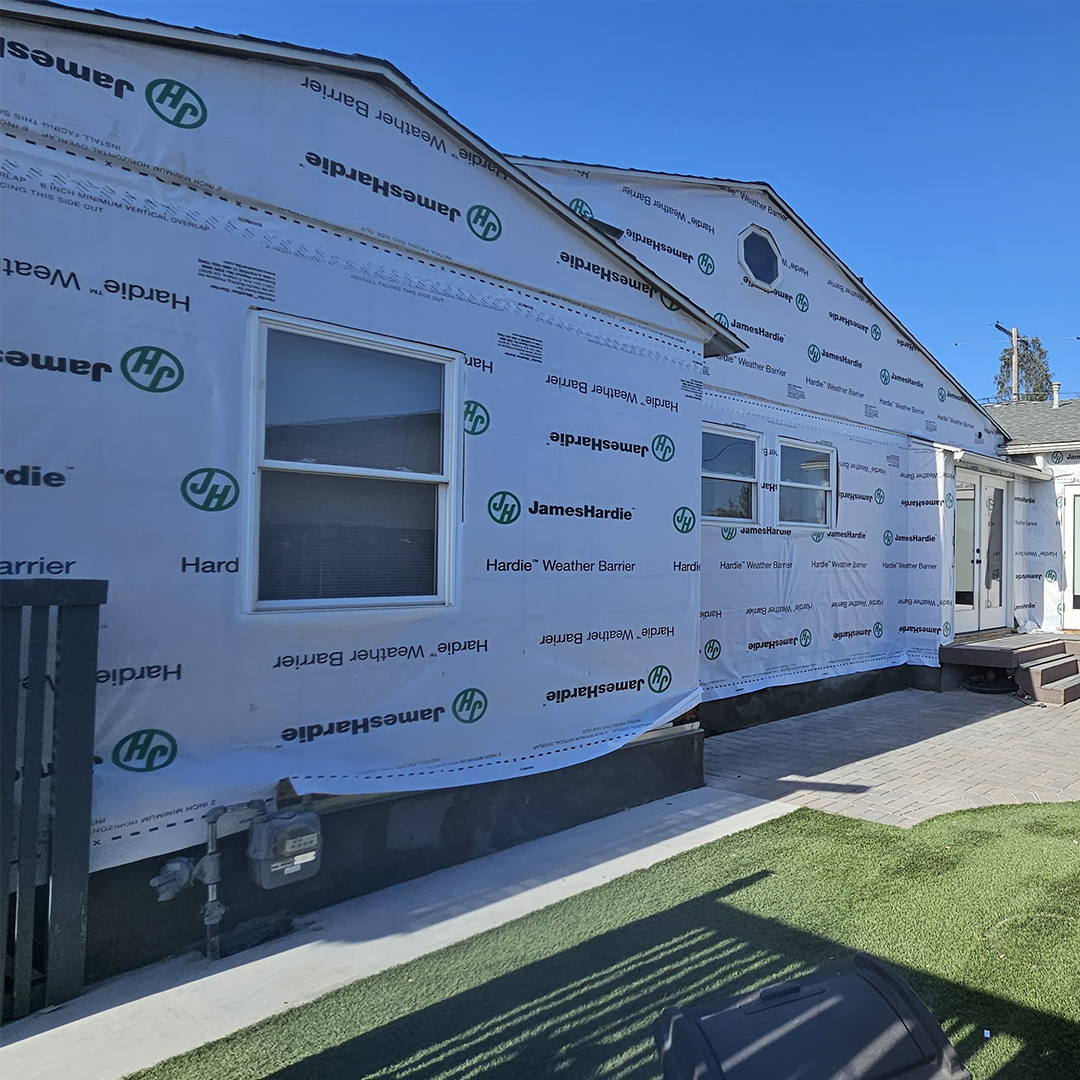
James Hardie’s answer to this challenge is HardieWrap® Weather Barrier, a product specifically engineered to work alongside James Hardie siding products and to outperform standard house wrap options.
Material and Construction. HardieWrap is made from a non-perforated, non-woven polyolefin — a high-performance synthetic material. Unlike some standard woven house wraps, which can allow water to seep through the fabric itself, HardieWrap’s non-perforated construction provides a more complete physical barrier against bulk water.
MicroTech™ Coating. What really sets HardieWrap apart is its patented MicroTech coating technology. This coating creates a strong barrier against bulk water and wind-driven rain while still allowing the material to breathe — letting moisture vapor escape from the inside out. This keeps the space within your wall cavity drier and helps prevent the conditions that lead to mold and mildew growth.
Durability and Thickness. At 11-mil thickness, HardieWrap is more durable than many standard house wrap products. That added thickness makes it more resistant to tearing during installation — an important practical advantage when working on full exterior re-siding projects where the material is handled extensively.
UV Stability. HardieWrap® is designed with extended UV resistance, meaning it can remain exposed during the construction process without degrading as quickly as lower-grade wraps. On real-world job sites where schedules shift and siding installation doesn’t always happen immediately, that stability matters.
The Full Hardie™ Weather Barrier System
HardieWrap® is the foundation of a broader system. James Hardie offers a complete suite of weather barrier products designed to work together as a continuous moisture and air control solution:
- HardieWrap® Weather Barrier — the primary housewrap membrane that resists moisture while allowing vapor to escape
- Pro-Flashing — peel-and-stick flashing for windows and doors that self-seals around fasteners, preventing water from entering at vulnerable openings
- Flex Flashing — stretchable flashing tape that conforms to irregular shapes, curved surfaces, and complex transitions
- Seam Tape — seals overlaps and joints in the wrap itself, creating a continuous, uninterrupted protective envelope around the entire structure
Each of these components addresses a specific point where water intrusion is most likely to occur. Together they form a layered system rather than a single product, which is what makes the installation more comprehensive than a standard house wrap application alone.
Why This Matters Specifically for San Diego Homes
San Diego’s climate is often described as mild, and in many ways it is. But the coastal environment creates a specific set of conditions that make proper moisture management important even in a region that rarely sees heavy rain.
Marine layer moisture. Coastal neighborhoods from Coronado to Encinitas deal with persistent marine layer, a low marine fog that settles in overnight and through the morning. This moisture doesn’t come in as rain, but it is consistent exposure that affects building materials over time. A well-installed weather barrier helps manage this low-level but ongoing moisture intrusion.
Wind-driven rain. When it does rain in San Diego, particularly during late fall and winter storm events, the rain often comes in sideways. Wind-driven rain is one of the primary ways water gets behind siding, and it is exactly what a moisture barrier is designed to intercept.
Salt air. Homes near the coast are also exposed to salt-laden air, which can be corrosive to building materials and fasteners over time. Protecting the wall cavity from moisture exposure reduces the risk of premature deterioration behind the siding.
Temperature cycling. The temperature difference between a cool marine morning and a warm afternoon creates daily expansion and contraction in building materials. Over many years, this cycling can open small gaps in siding systems. A weather barrier serves as a continuous backup layer behind those gaps.
What Happens Without One?
When a weather barrier is missing, improperly installed, or simply worn out after decades, water that finds its way behind the siding has direct access to the wall sheathing and framing. The consequences can include:
Mold and mildew growth. Once moisture becomes trapped in a wall cavity, it creates the conditions mold needs to thrive. Mold inside walls is not always visible until it has already spread, and remediation can be costly.
Wood rot. Wall framing and sheathing that is repeatedly exposed to moisture will eventually begin to rot. In some cases, this damage is not discovered until a siding replacement project reveals the extent of the deterioration underneath.
Reduced insulation performance. Wet insulation does not perform as designed. Moisture in wall cavities can cause insulation to compress, sag, or lose its effectiveness, increasing energy costs over time.
Shorter exterior lifespan overall. Even high-quality fiber cement siding performs better and lasts longer when the system underneath it is properly sealed and protected.
Installation: Why It Has to Be Done Right
A moisture barrier is only as effective as its installation. HardieWrap should overlap at least one inch on the sides and six inches at the ends to maintain continuous coverage. All seams need to be sealed with HardieWrap Seam Tape, and all window and door openings require proper flashing before the wrap is lapped over them.
Gaps, improperly lapped seams, or missing tape at joints are points where water can infiltrate despite the barrier being present. This is why experience with the full system — not just the siding itself — matters when choosing a contractor.
As a James Hardie Certified Installer, CertEX Construction is trained to install James Hardie products, including the HardieWrap Weather Barrier system, according to manufacturer specifications. That certification means the installation meets the standards required for full James Hardie warranty coverage — including the components you never see once the siding goes on.
Protect Your Home from the Inside Out
The siding on your home is what neighbors see. The weather barrier is what protects the structure behind it. When both are installed correctly and work as a system, your home’s exterior is far more capable of handling moisture, wind, and time than either component would be alone.
If you are planning a siding replacement or new exterior installation, it is worth asking about what goes on underneath, not just what goes on top. Contact CertEX Construction to learn more about HardieWrap® and professional exterior installation in San Diego.